
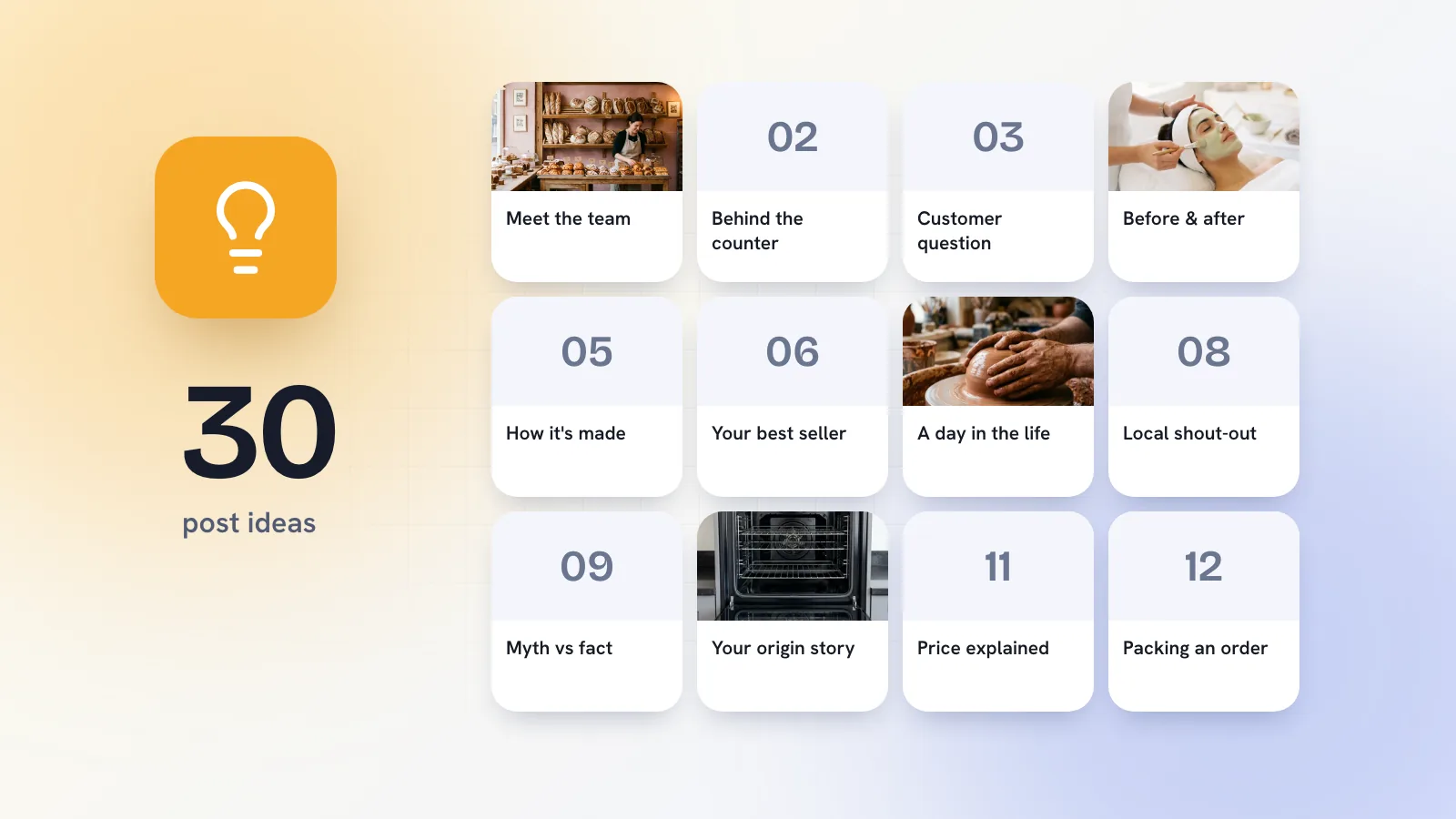
Trends move fast and most of them have nothing to do with selling coffee, cutting hair or fixing boilers. The posts that bring customers through the door tend to be quieter: they show what you do, who does it and why someone nearby should care. Here are 30 ideas that work for cafés, salons, shops, studios and trades, grouped so you can drop them into a weekly plan.
Why skip trends?
Trends aren't bad, they're just a poor fit for most local businesses. They take time to film, they date quickly and they reach people who will never visit. Instagram has also said it's pushing original content over reposted and recycled material, which favours posts only you could make. Everything below is original by default, because it's about your business. More on that in our piece on Instagram's original content push.
Behind the scenes ideas (1 to 6)
- 1. The opening routine. Film the first 15 minutes of your day in quick cuts: keys, lights, coffee machine, chairs down.
- 2. Prep nobody sees. The 6am bake, the colour mixing, the stock count. Effort that happens before customers arrive builds trust.
- 3. A tool you couldn't work without. Show it, say why, and what you'd tell someone buying their first one.
- 4. A mistake and the fix. The batch that didn't rise, the delivery that came wrong. Honest posts tend to get more replies than polished ones.
- 5. Closing up. The last customer, the clean-down, the lights off. A calm end to the day is oddly watchable.
- 6. Your workspace as it really is. Not styled. The notes on the fridge, the playlist, the corner where staff eat lunch.
Ideas that show what you sell (7 to 12)
- 7. One product, close up. A single item with the price and one line on why you stock or make it.
- 8. The menu or price list, one item per slide. A carousel people can save and come back to.
- 9. What's new this week. New stock, a new dish, a new treatment. Say when it's available and until when.
- 10. Staff picks. Each person chooses one thing and says why in a sentence.
- 11. Which one are you? Two or three options side by side, and ask people to pick in the comments.
- 12. What it actually costs. A clear breakdown of a popular service or product. People appreciate not having to message to find out.
Ideas about your people (13 to 18)
- 13. Meet the team, one person at a time. A photo, their role and one thing customers wouldn't guess about them.
- 14. Why you started. The owner's story in a few honest lines. Save this for a slow week and pin it.
- 15. A regular's usual order. With permission, share what someone has every time and how long they've been coming.
- 16. Your suppliers. The farm, the roaster, the maker, the wholesaler. Tag them and they'll often share it.
- 17. A customer review in their words. Screenshot or quote, with a photo of the thing they loved.
- 18. A day with a new starter. Their first week, what they've learned, what surprised them.
How-to and teaching ideas (19 to 24)
- 19. The question you get asked most. Answer it once properly and point people to the post next time.
- 20. Three mistakes people make. Brewing coffee at home, washing coloured hair, watering a fiddle-leaf fig.
- 21. How to choose. Which cut, which bean, which size. A simple guide that makes buying easier.
- 22. Aftercare. What to do in the days after a treatment, a repair or a purchase.
- 23. Myth versus fact. One common belief in your trade and what's actually true.
- 24. A 30-second tutorial. One small skill people can try at home, filmed from above.
Local and neighbourhood ideas (25 to 30)
- 25. How to find you. A walk from the nearest station or landmark to your door.
- 26. Your favourite neighbours. Three local businesses you love, tagged, with a line on each.
- 27. Local events. The market, the street festival, the school fair. Say if you'll be there or open late.
- 28. The street through the seasons. Same spot, different months. Easy to plan and nice to look back on.
- 29. A question for locals. What should we stock next? What's missing on this street? Then reply to every answer.
- 30. A thank you. After a busy weekend, a milestone or a tough month, thank the people who turned up.
How do you turn these ideas into a plan?
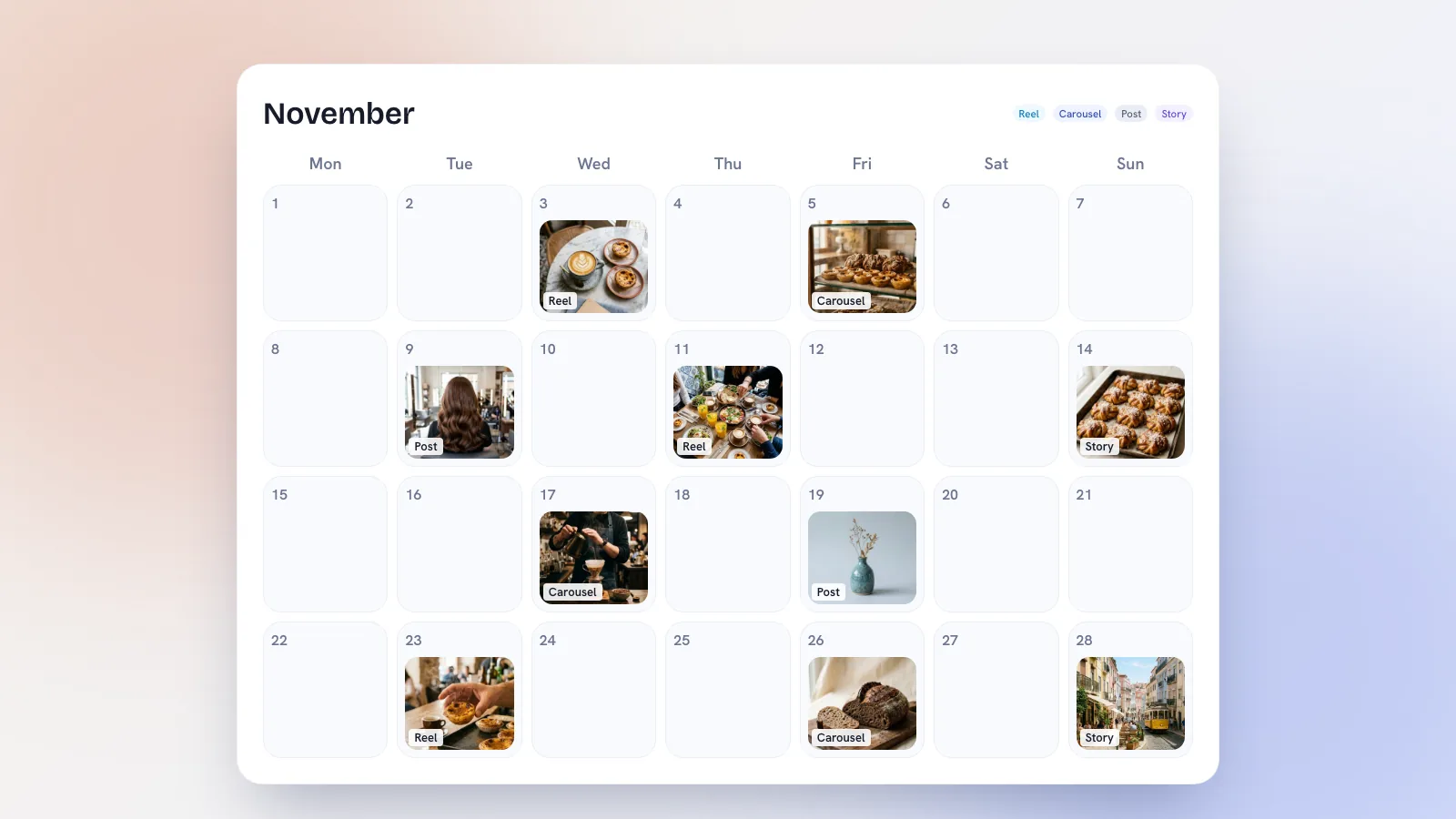
Thirty ideas is roughly two months of posting at three or four times a week. Don't post them in order. Rotate between the groups so each week has something about your work, your offer, your people and your place. Our content calendar template shows how to lay that out over four weeks, with versions for a café, a salon and a shop.
Then decide the format for each slot. Teaching ideas tend to suit carousels because people save them. Behind-the-scenes and how-to-find-us ideas suit short Reels. If you're unsure which to pick, read carousels vs Reels in 2026.
What if you run out of ideas?
Write down every question a customer asks you for a week. Each one is a post. Look at what's getting saved and shared among similar businesses in your area, then make your own version rather than copying it. And repeat what worked: if a post about your opening routine did well in spring, do a new one in autumn.
This is where Content Studio helps if you'd rather not start from a blank page. Kebo suggests ideas backed by posts that are working in your niche right now, with a short note on why each one fits. For each idea it writes three hooks, a caption for each platform and a Reel script, and designs carousels in your brand colours and fonts. Publisher then schedules them across Instagram, Facebook, Threads and TikTok. If you run a café or restaurant, see how it fits a typical week on our cafés and restaurants page.