
Scroll any local business feed and you can spot the AI captions in a second. They start with a question nobody asked, promise to "elevate your experience" and end with three rocket emojis. People scroll past them, and more of your customers notice than you might think. This guide shows you how to pin down the way you actually talk, turn it into rules you can check against, and use AI to save time without sounding like everyone else.
What is a brand voice, and why does it matter on social media?
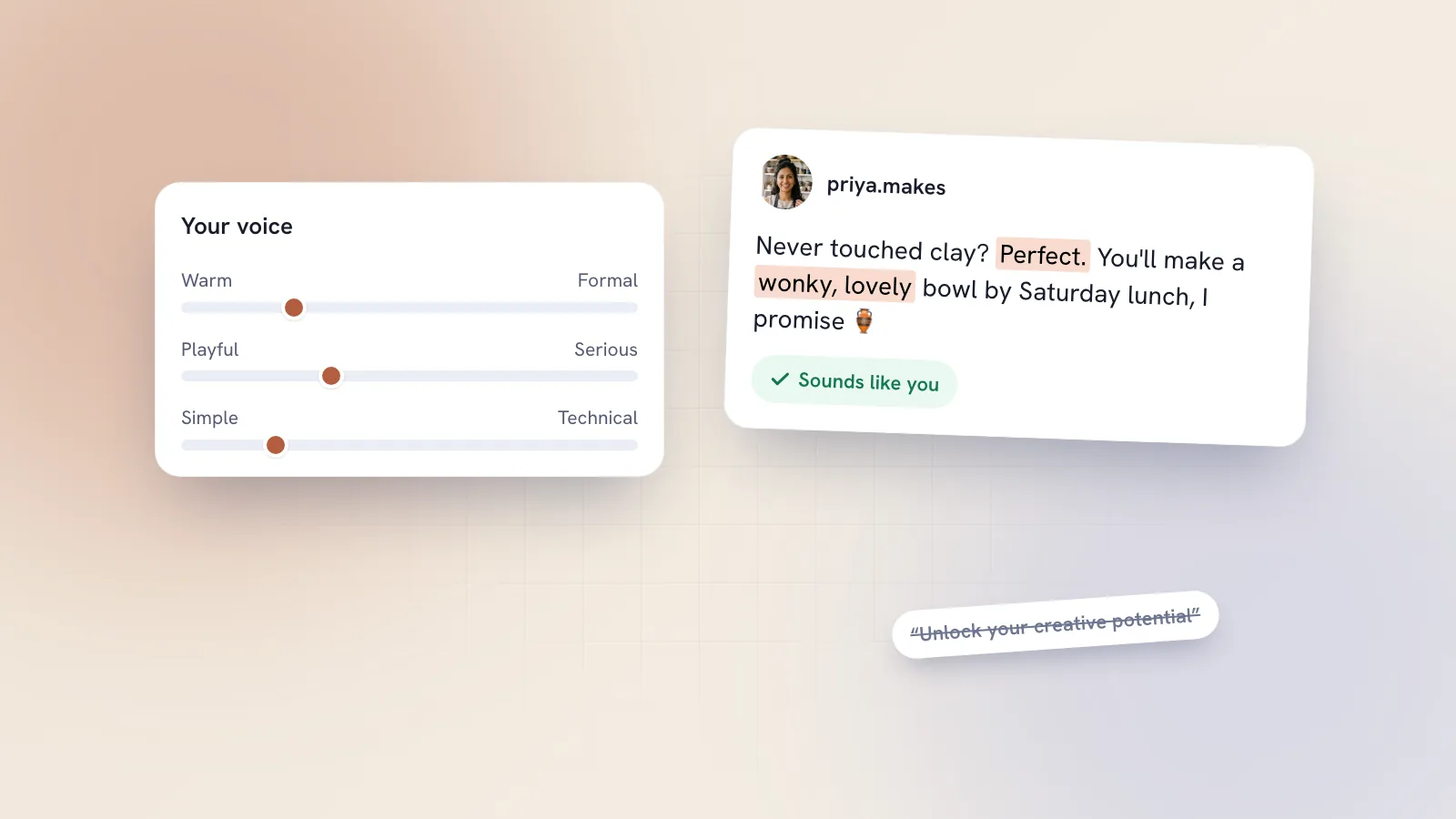
Your brand voice is how your business sounds when it writes. Not your logo or your colours, but your words: the ones you reach for, the ones you'd never say, how long your sentences run and whether you crack a joke. A good voice makes a caption recognisable before anyone sees your handle.
On social media it matters for a simple reason. Most of what people see in their feed is interchangeable. A café posting "Start your morning right with our delicious coffee" sounds like every café. A café posting "The oat flat white is back to how it should be. We changed milk supplier and you told us, loudly" sounds like one particular place with one particular owner. The second one gets replies, because it sounds like a person wrote it.
Platforms are moving the same way. Instagram has been pushing original content over reposted and aggregated posts (see our piece on Instagram's original content push), and generic AI-written content is increasingly ignored by the people scrolling. Sounding like yourself is not a nice extra any more. It is how you get noticed at all.
Why do AI captions sound like AI?
It helps to know what you are trying to avoid. When you ask a general AI tool for "an Instagram caption for my bakery" with no other context, it fills the gaps with the safest, most average writing it can. That average has a recognisable shape:
- Hype words with no meaning: elevate, indulge, unleash, treat yourself, game-changer, look no further.
- Openers that ask an empty question: "Are you ready to...?", "Who else loves...?", "Looking for the perfect...?"
- Even rhythm: every sentence roughly the same length, often in threes ("fresh, local and delicious").
- No specifics: no names, prices, times, streets or details only you would know.
- Emoji confetti and a hashtag block that looks copied from a list.
- A soft, generic close: "Don't miss out!" or "Tag a friend who needs this!"
None of these are crimes on their own. Together they make a caption that could belong to any business in any city. The fix is not a better prompt. It is giving the writer (you, a team member or a tool) a clear picture of how you sound and the specific facts to work with.
How do you define your brand voice?
You don't need a 40-page brand book. You need one page that anyone on your team could use to check a caption. Block out an hour, open your last few months of posts, and work through these five parts.
1. Start from captions you're already proud of
Pick five to ten captions, DMs or replies that sounded right. They're usually the ones you wrote quickly, about something real, that got people talking. Copy them into one document. These are your evidence. Everything else in your voice guide should be a description of what these have in common.
2. Make a list of words you use and words you never use
This is the most useful part of the whole exercise. Look through your examples and pull out the words and phrases that are yours. Then write the list of words you would never say, which is often the faster list to fill.
| Business | Words we use | Words we never use |
|---|---|---|
| Fig & Ember (café, Lisbon) | brunch, the bar, beans, Príncipe Real, "see you at the window seat" | indulge, foodie heaven, treat yourself, yummy |
| A PT studio | sessions, form, strength, "you'll feel it tomorrow" | beach body, shred, no excuses, transformation |
| A physio clinic | assessment, recovery, "what's actually going on" | miracle, quick fix, pain-free guaranteed, cure |
Be honest about the "never" list. If you'd cringe hearing it read out loud in your shop, it goes on the list.
3. Decide on sentence length and rhythm
Read your best captions out loud. Do you write in short, punchy lines? Long, chatty sentences with asides? A mix? Write down a rule you can check, such as "mostly short sentences, one longer one is fine, never more than three lines before a line break". Rhythm is a big part of why a caption sounds like a person, and it's the part most AI drafts get wrong.
4. Decide how you open and how you close
The first line decides whether anyone reads the rest. Pick two or three openers that feel like you. For example: start with a specific detail ("Tuesday's sourdough came out of the oven at 6:40"), start with something a customer said, or start with a plain statement of news. Then pick how you close: a question you'd genuinely like answered, a clear next step ("Book through the link in bio"), or a sign-off you always use. Ban the closers you'd never say.
5. Set a few tone rules
Finish with three to five short rules about attitude. Keep them concrete enough to check:
- We name real things: the dish, the price, the street, the person.
- We're warm but we don't gush. One exclamation mark per caption, maximum.
- We can laugh at ourselves. We never laugh at customers.
- We use emojis sparingly, and only ones we'd send to a friend.
- We say what we can't do. We don't over-promise.
Before and after: caption rewrites for three businesses
Here's what applying a voice guide looks like in practice. Each "before" is the kind of caption a general AI tool produces from a one-line prompt. Each "after" uses the business's own words, a specific detail and its normal way of closing.
A café: Fig & Ember launches an autumn menu
Before: Fall in love with fall! 🍂☕ Indulge in our delicious new seasonal menu, crafted with love to elevate your brunch experience. Cosy vibes, amazing flavours and the perfect spot to treat yourself. Don't miss out! #brunch #coffee #autumnvibes #foodie
After: Autumn menu starts Saturday. The one people will ask about: roasted pumpkin on sourdough with whipped feta and chilli honey. The one we're proudest of: a fig and cardamom latte made with figs from a farm outside Sintra. Window seats go by 10. See you there.
What changed: a date, two named dishes, a real supplier detail, a local reference and the café's usual short sign-off. No hype words, one emoji's worth of warmth carried by the words instead.
A personal trainer: a new small-group strength class
Before: Ready to transform your body and unleash your inner strength? 💪🔥 Our NEW small group classes are the ultimate game-changer for your fitness journey! No excuses, just results. DM us now to secure your spot! 🚀
After: New on Thursdays at 7am: small-group strength, four people maximum. We'll spend the first two weeks on form for squats, hinges and presses before adding weight, so it's a good one if you've been nervous about the free weights section. £15 a session. Message me "Thursday" and I'll send the details.
What changed: the time, the group size, what actually happens in the class, who it's for, the price and a clear keyword to message. It addresses a real worry instead of shouting.
A physio clinic: an educational post about back pain
Before: Struggling with back pain? 😣 You're not alone! Our expert team is here to help you on your journey to a pain-free life. Discover the power of physiotherapy and take the first step towards a healthier, happier you today! ✨
After: The question we hear most in first appointments: "Should I rest my back until it stops hurting?" Usually, gentle movement helps more than lying still, but it depends on what's going on. That's what the first assessment is for. If it's been bothering you for more than a couple of weeks, book in and we'll work out a plan together.
What changed: it opens with a real question patients ask, gives a useful and careful answer, avoids promising a cure and ends with a calm next step. It sounds like a clinician, not an advert.
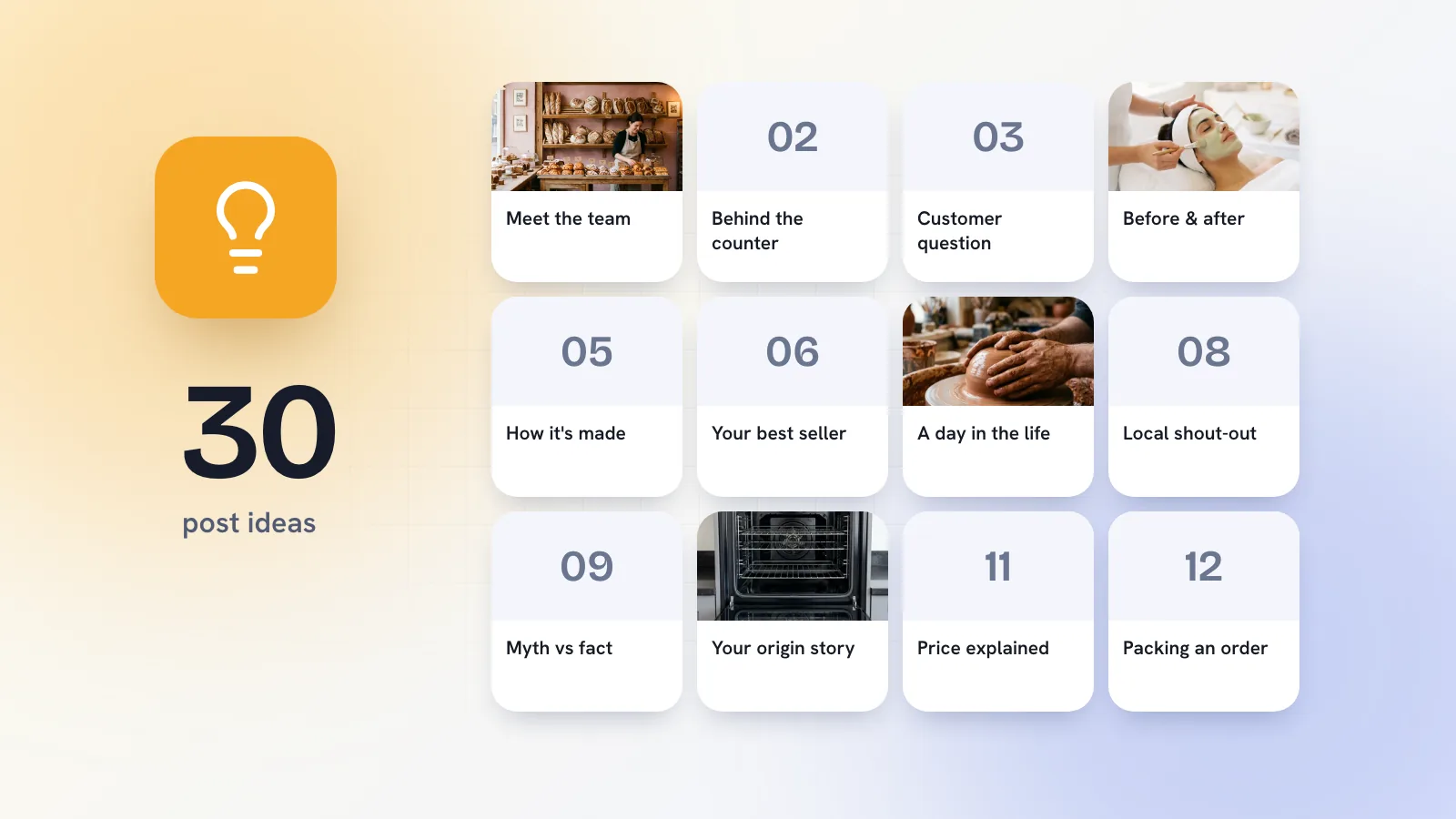
Notice the pattern across all three. The "after" versions are not more clever. They are more specific. If you're short on things to be specific about, our list of 30 post ideas for local businesses is built around real details from your week.
How do you use AI to write captions without sounding like AI?
AI is genuinely useful for captions. It's fast at first drafts, at rewriting one caption for three platforms and at getting you past a blank page. The trick is to treat it as a drafter, not a writer. You bring the voice and the facts; it brings speed; you do the final edit.
Give it your voice, not just the topic
Paste your one-page voice guide and two or three of your best captions into the prompt every time, or use a tool that keeps them for you. Then give it the facts: what, when, how much, who it's for and one detail only you would know. "Write a caption about our autumn menu" gets you the "before" above. A prompt with your words list, your example captions and the pumpkin-on-sourdough detail gets you most of the way to the "after".
Edit every draft with a checklist
Never post an AI draft untouched. Run each one through this quick edit, which takes a minute or two once it's a habit:
- Cut the first line if it's a question nobody asked. Start with the detail instead.
- Search for your "never" words and replace them with plain ones.
- Add one specific: a name, a time, a price, a street, a thing a customer said.
- Break the even rhythm. Make one sentence much shorter than the rest.
- Trim the emojis and hashtags to what you'd actually use.
- Swap the closer for one of yours.
- Read it out loud. If you wouldn't say it to a regular at the counter, change it.
Write per platform, not once for everywhere
Your voice stays the same across platforms, but the format doesn't. An Instagram caption can carry a short story. A Threads post reads better as a conversation starter or a short thread. A TikTok caption is closer to a search query, with the keywords people would type (more on that in TikTok search for local customers). Ask for a separate draft for each one rather than pasting the same text everywhere.
How do you keep your voice consistent across a team?
Once more than one person posts or replies for the business, your voice starts to drift. A few habits keep it steady:
- Keep the voice guide where people write. A pinned note on the shared phone or a doc linked in your scheduler beats a PDF nobody opens.
- Include replies, not just posts. Comments and DMs are where your voice is tested most. Add three or four example replies to common questions to your guide. Our Instagram DM sales scripts are a good starting point to adapt.
- Review a week of posts once a month. Read them in a row. Anything that sounds off, rewrite it and add the lesson to the guide.
- Update the guide when the business changes. A new menu, a new service or a new audience usually means a few new words on the "use" list.
If you run a salon, clinic, café or shop, our page for local businesses shows how this fits into a normal working week.
A one-page brand voice template
Copy this into a note and fill it in. It should fit on a single screen.
- Who we are, in one sentence: what you do, where, and for whom.
- We sound like: three words (for example, "friendly, direct, a bit dry").
- Words we use: 10 to 15 words and phrases from your real captions.
- Words we never use: 10 to 15 words you'd cringe at.
- Rhythm: your sentence length and line break rules.
- How we open: two or three opener styles, with an example of each.
- How we close: your usual calls to action and sign-offs.
- Emojis and hashtags: which ones, and how many.
- Five captions we're proud of: pasted in full.
Once it's written, plan your posts around it. A content calendar template makes it easier to write several captions in one sitting, which is where a consistent voice really pays off.