
Most personal trainers don't have a content problem. They have a camera roll full of form checks and gym clips, and a diary with gaps in it. The missing piece is the path between the two: a profile that explains what you do, posts that show how you coach, and a way of turning a comment or a DM into a booked consultation. This guide walks through each step, for trainers who coach in person, online, or both.
Can you really get personal training clients from Instagram?
Yes, but rarely from a single viral Reel. In our experience, PT clients come from a slower loop: someone nearby sees a useful post, checks your profile, watches a few more, then sends a message when the timing is right for them. Your job is to make each step of that loop easy. Followers matter far less than whether the right fifty people in your area, or in your niche, recognise your name.
How should a personal trainer set up their Instagram profile?
Your profile is your shop window. Instagram says using a handle or profile name related to what you post is your best bet for showing up in relevant searches, and that adding your location to your bio makes it easier for people in your area to find you. So put the words people actually search into the name field, not just your name.
- Name field: your name plus what you do and where. 'Sam Okafor | Personal Trainer Leeds' or 'Priya | Online Strength Coach'. This is separate from your @handle and is easy to change.
- Bio: who you help, the result, where or how, and one next step. More on this below.
- Link: one link that goes straight to booking a consultation or a short page with your prices. Instagram allows up to five links, but the first one is the one people see, so make it the booking link.
- Highlights: five at most. 'Start here', 'Results', 'Prices', 'FAQs' and 'Online' cover most questions before anyone has to ask.
- Contact button: if you have a professional account, add email or a booking button so people who don't like DMs can still get in touch.
A personal trainer Instagram bio formula (with 5 examples)
Bios are short, so every line has to earn its place. A formula that works: who you help + the result they want + where or how + one call to action. Skip vague lines like 'Fitness enthusiast' or 'Living my best life'.
| Trainer | Bio |
|---|---|
| In-person PT, general | Helping busy Leeds parents get strong in 3 sessions a week 🏋️ Private studio, Headingley. Free consult ↓ |
| Online strength coach | Online strength coaching for women new to lifting. Custom plan, weekly check-ins, video form reviews. DM 'PLAN' to start |
| Run coach | Run coach + PT, Bristol. Stronger legs, fewer niggles, faster 10Ks. Group sessions Sat 8am. Book below |
| Pre and postnatal PT | Pre and postnatal trainer, Manchester. Safe, steady strength for pregnancy and after. Physio-referred clients welcome |
| Over-50s specialist | Strength training for over-50s in Brighton. Better balance, easier stairs, no burpees. Consults below |
Notice what each one does: names a specific person, a place or a format, and tells you what to do next. If you train online and in person, lead with whichever brings you more money and mention the other in your highlights.
What should a personal trainer post on Instagram?
Workout clips alone won't make anyone choose you, because every trainer posts them. People book the trainer whose approach they understand and trust. A balanced mix looks something like this:
| Content type | What it does | Example |
|---|---|---|
| Form tips | Shows you know your stuff | 'Why your squat feels it in your knees, and the fix' |
| Client stories | Shows real people get results with you | A client in their own words on finally doing a pull-up |
| Myth-busting | Shows your point of view | 'You don't need to be sore for a session to count' |
| Transformations (with consent) | Shows outcomes | Strength numbers, energy, confidence, not just body shots |
| Day in the life | Shows who you are | Your 6am to 8pm day in 30 seconds |
20 personal trainer Instagram post ideas
Each of these works as a Reel or a carousel. Pick the format you can make well this week.
- The three mistakes you correct most often in new clients.
- A 'what a first session with me looks like' walkthrough.
- One exercise, three ways: easier, standard, harder.
- A client's first session versus their session three months in.
- The one stretch or drill you give almost everyone, and why.
- Myth: 'Lifting makes women bulky'. Your honest answer.
- What you'd do with only 20 minutes and a pair of dumbbells.
- A client story in their own words (with consent).
- Your answer to 'how often should I train?' for a complete beginner.
- A gym tour for nervous first-timers: where to start, what to ignore.
- Desk-worker warm-up: five minutes before any session.
- What you eat on a busy coaching day (no meal plans or medical advice).
- The question you get asked most in DMs, answered properly.
- How you plan a client's week, shown on a whiteboard.
- A myth from your niche, like 'running ruins your knees', unpicked.
- Behind the scenes: your 6am session set-up.
- A frequently asked price question: what's included in a block of sessions.
- A shout-out to a local physio, café or running club you love.
- A carousel checklist: 'signs you're ready to move up a weight'.
- Your own training: what you're working on and what's hard.
If you want more ideas built around your own business, our list of 30 post ideas for local businesses adapts well to studios and gyms.
Should personal trainers post Reels or carousels?
Both, for different jobs. Reels are better for reaching people who don't follow you yet: movement, form and personality come across in video. Carousels are better for saving and sharing: a checklist, a weekly plan, a myth-buster someone sends to a friend. Adam Mosseri, head of Instagram, said in early 2025 that the signals that matter most for ranking are watch time, likes and sends, and suggested creators look at average watch time, likes per reach and sends per reach in their insights. A form tip a gym-goer sends to their training partner is exactly the kind of post that does well.
Instagram has also been clear that it wants to recommend original content over reposted material. For trainers this is good news: your own clients, your own coaching cues and your own gym are original by default. For a deeper comparison, read carousels vs Reels in 2026.
How often should a personal trainer post on Instagram?
Pick a rhythm you can keep up through a busy January, not one that only works in a quiet August. Here's a realistic week for a trainer with a full diary:
| When | What | Time it takes |
|---|---|---|
| Sunday | Plan the week and batch-film two Reels between your own sets | 45–60 minutes |
| Monday | Reel: a form tip | Scheduled |
| Wednesday | Carousel: a myth-buster or checklist | Scheduled |
| Friday | Reel or carousel: a client story or day in the life | Scheduled |
| Daily | Stories from sessions, plus 10–15 minutes engaging and replying | 15 minutes |
Three posts a week, every week, gives Instagram and your followers something steady. Batch-film when you're already at the gym and schedule posts so they go out while you're coaching.
How do you engage with local accounts to get clients?
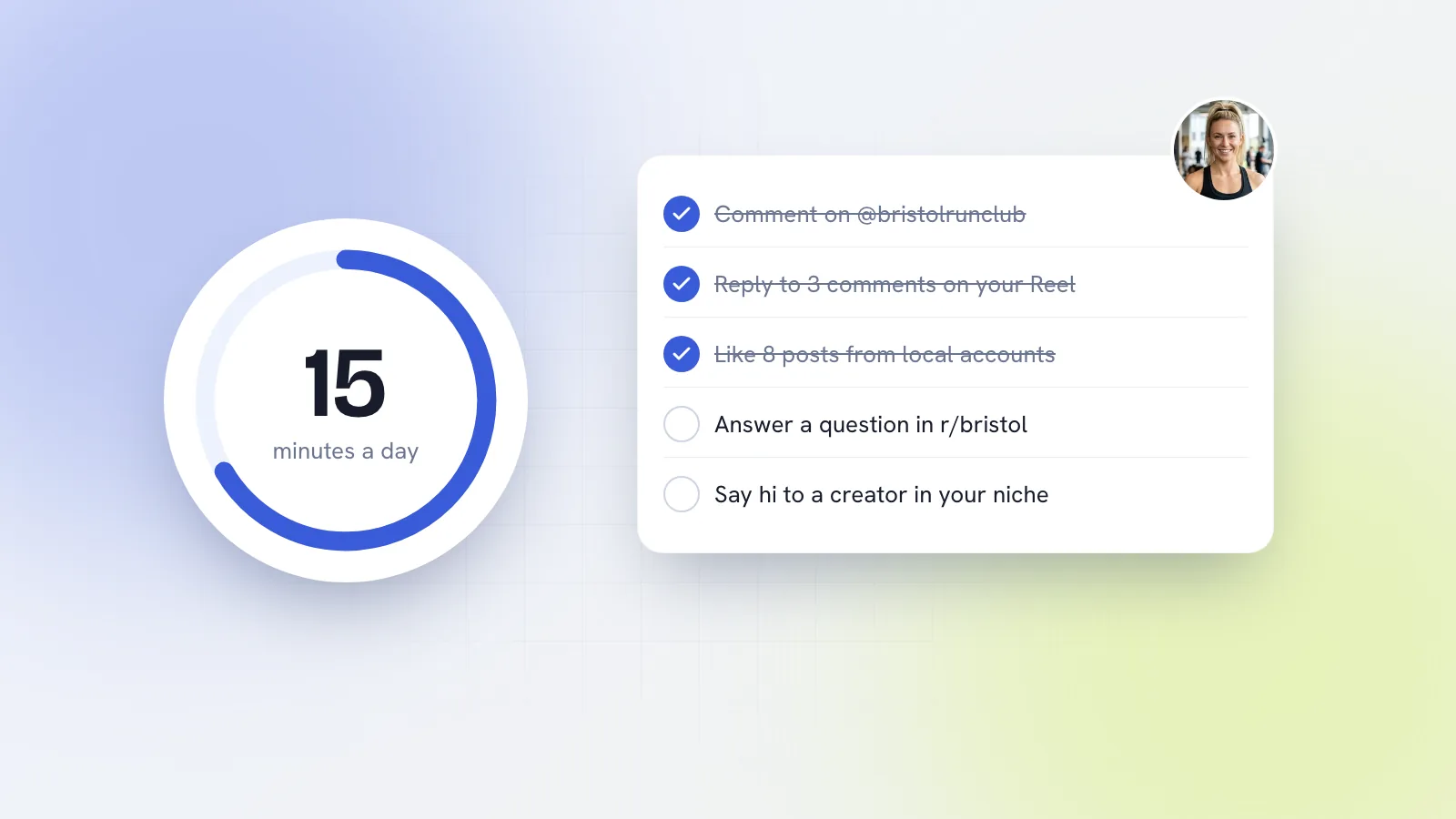
Posting gets you seen; engaging gets you known. Spend a few minutes a day leaving thoughtful comments on posts from accounts your future clients already follow:
- Local gyms and studios, especially ones without their own PTs.
- Physios, osteopaths and sports massage therapists, who often get asked 'who should I train with after rehab?'
- Running clubs, cycling clubs and parkrun groups near you.
- Local cafés, health food shops and community pages where people in your area hang out.
- Your own clients' posts, when they share a race or a milestone.
Comment like a person, not a promoter. 'Great tip on ankle mobility, I see this all the time with new runners' starts a relationship; 'Check out my page!' ends one. Our 15-minute engagement routine gives you a simple daily structure.
How do you turn comments and DMs into consultations?
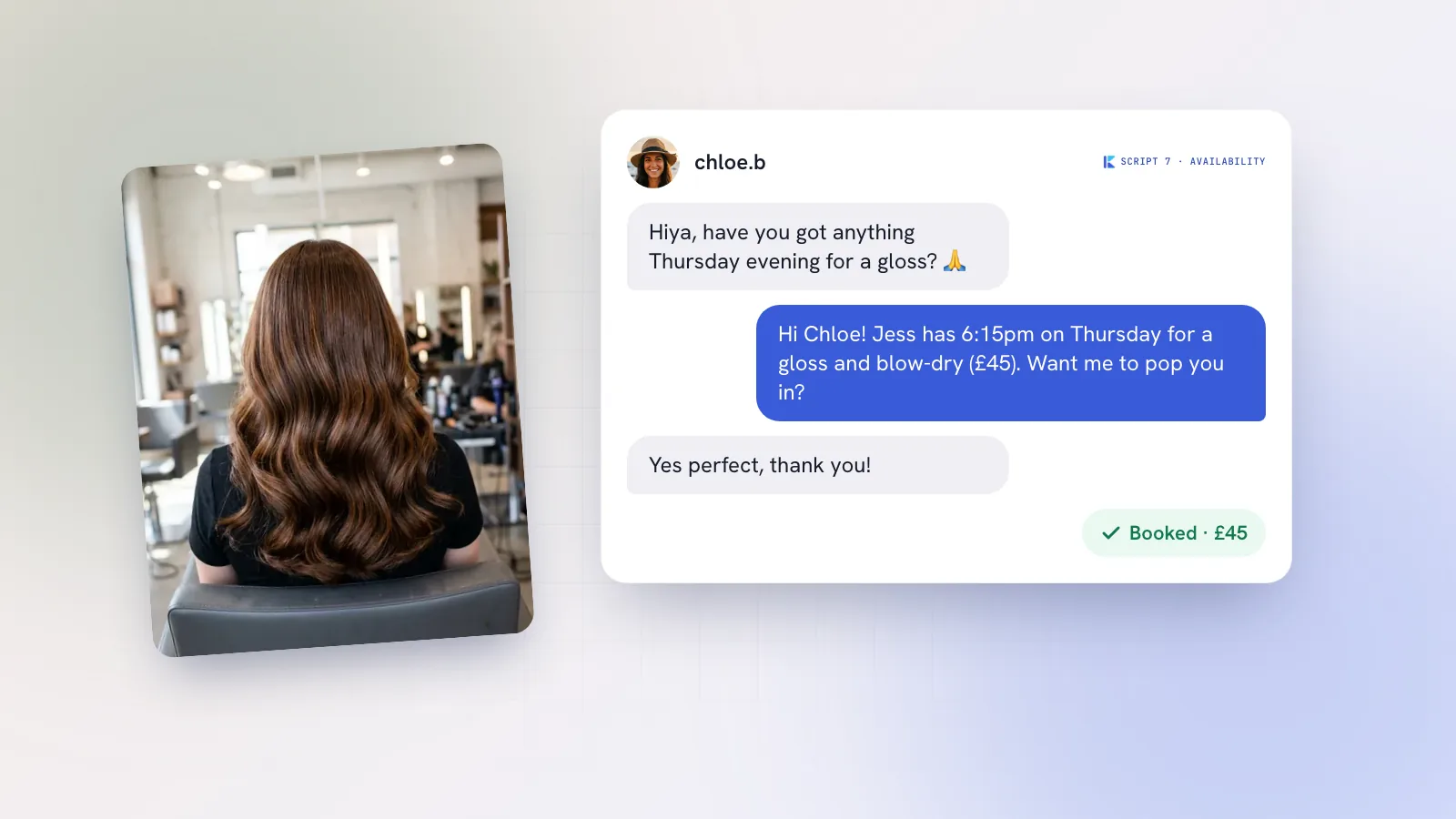
This is where most trainers lose clients: someone asks about prices at 7pm and gets a reply the next afternoon. Meta only lets businesses reply to Instagram DMs within 24 hours of the person's last message, so a slow reply can mean a lost conversation as well as a lost client.
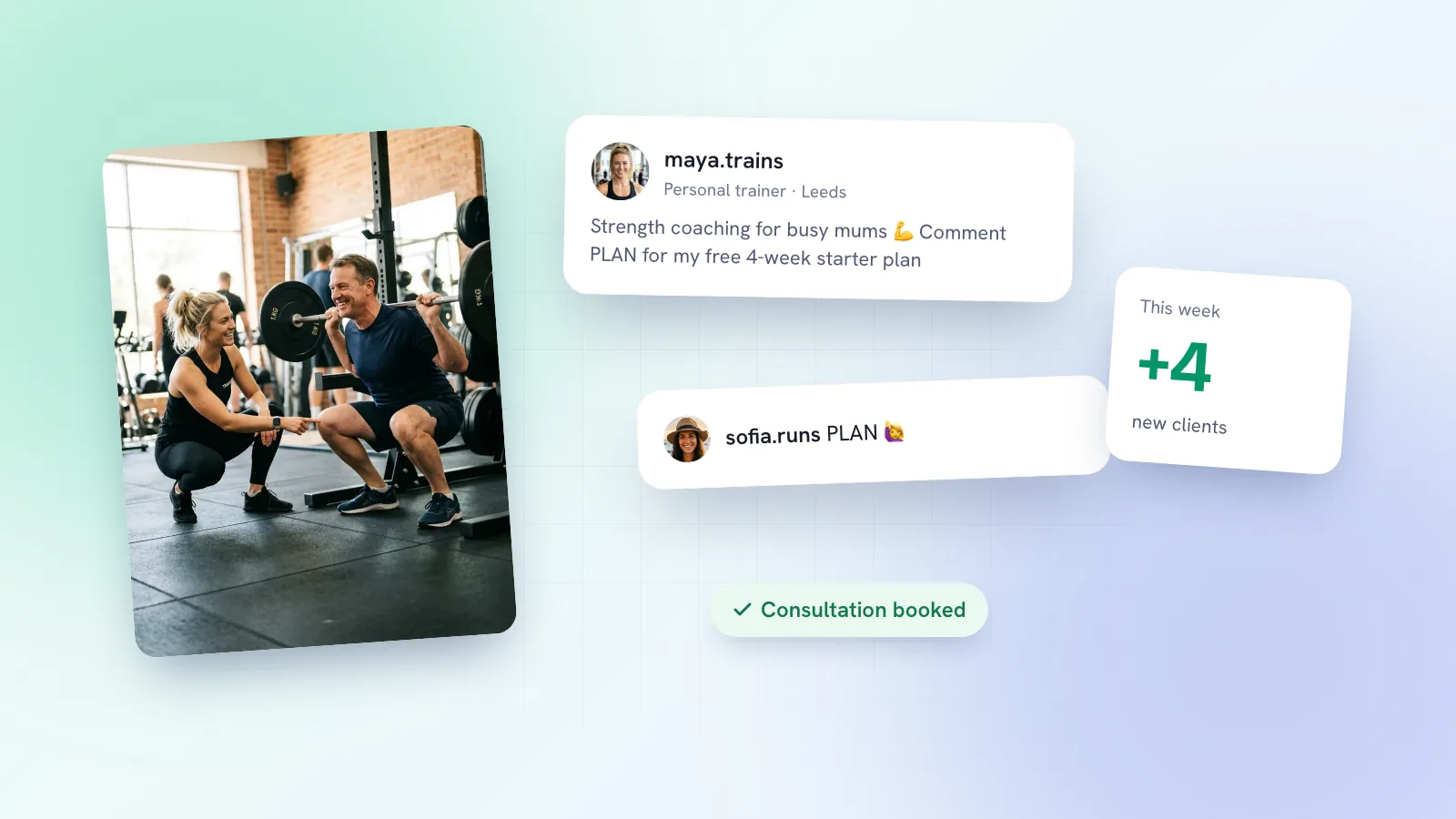
A comment-to-DM keyword makes the first step easy. On a post about your beginner plan, write 'Comment PLAN and I'll send you the details'. Everyone who comments PLAN gets a short DM you've written in advance. Our guide to comment-to-DM covers how to do it without feeling spammy. Then keep the conversation short and steer towards a call or a first session:
Hi Jess, here's the beginner plan: 6 weeks, 2 sessions a week at the Headingley studio, £240 including a programme for the days in between. Most people start with a free 20-minute consult so we can talk about goals and any injuries. Want me to send a couple of times this week?Comment-to-DM reply for the keyword PLAN
Good question! Online coaching is £120 a month: a custom plan in the app, a weekly check-in and form reviews on your videos. What are you training for at the moment? I'll tell you honestly if it's a good fit.Reply to 'how much is online coaching?'
Both replies give the price straight away, explain what's included and end with an easy question. For 20 more replies covering price objections, follow-ups and booking, see our Instagram DM sales scripts.
How is getting online personal training clients different?
The basics are the same, but the audience and the proof change.
| In-person PT | Online coaching | |
|---|---|---|
| Who you reach | People within travelling distance | Anyone in your niche, anywhere |
| Profile keywords | Your town or area, your gym | Your niche and who you help |
| Best proof | Local faces, your gym, reviews | Check-in examples, how the app works, client stories |
| Engagement | Local gyms, physios, clubs | Niche communities and creators your clients follow |
| What people worry about | Price and fitting it into their week | Whether they'll stick at it without you in the room |
Because you're competing with trainers everywhere online, a clear niche matters more: 'strength for runners' or 'lifting for women over 40' is easier to choose than 'online PT'. Show how the coaching actually works week to week, because that's the bit people can't picture.
What should personal trainers avoid on Instagram?
- Buying followers or engagement. It inflates a number that doesn't pay you, and fake accounts never book a session.
- Cold DM spam. Messaging strangers 'Hey, want to get in shape?' annoys people and makes you look desperate. Let people come to you through comments, Stories and posts.
- Unrealistic before-and-afters. Lighting tricks, pump and posing tell people you'll mislead them. If you ever turn a post into an ad, Meta's advertising standards don't allow side-by-side weight-loss comparisons at all.
- Medical claims. Don't promise to fix back pain, cure conditions or prescribe diets beyond your qualifications. Refer to a physio, GP or dietitian, and say so on camera; it builds trust.
- Copying other trainers' content. Reposting viral workouts dilutes your own voice, and Instagram favours original posts in recommendations.
Where Kebo fits in
Everything above works with a phone and a notebook. If you'd rather spend your spare time coaching, Kebo for fitness trainers handles the busywork. Content Studio suggests ideas backed by posts that are working in fitness right now, writes Reel scripts with scored hooks, and designs carousels in your colours and fonts. The Inbox drafts every DM and comment reply in your voice, with your prices and booking link, and shows how much of the 24-hour window is left. You read it and press Send, and it never messages anyone first.