
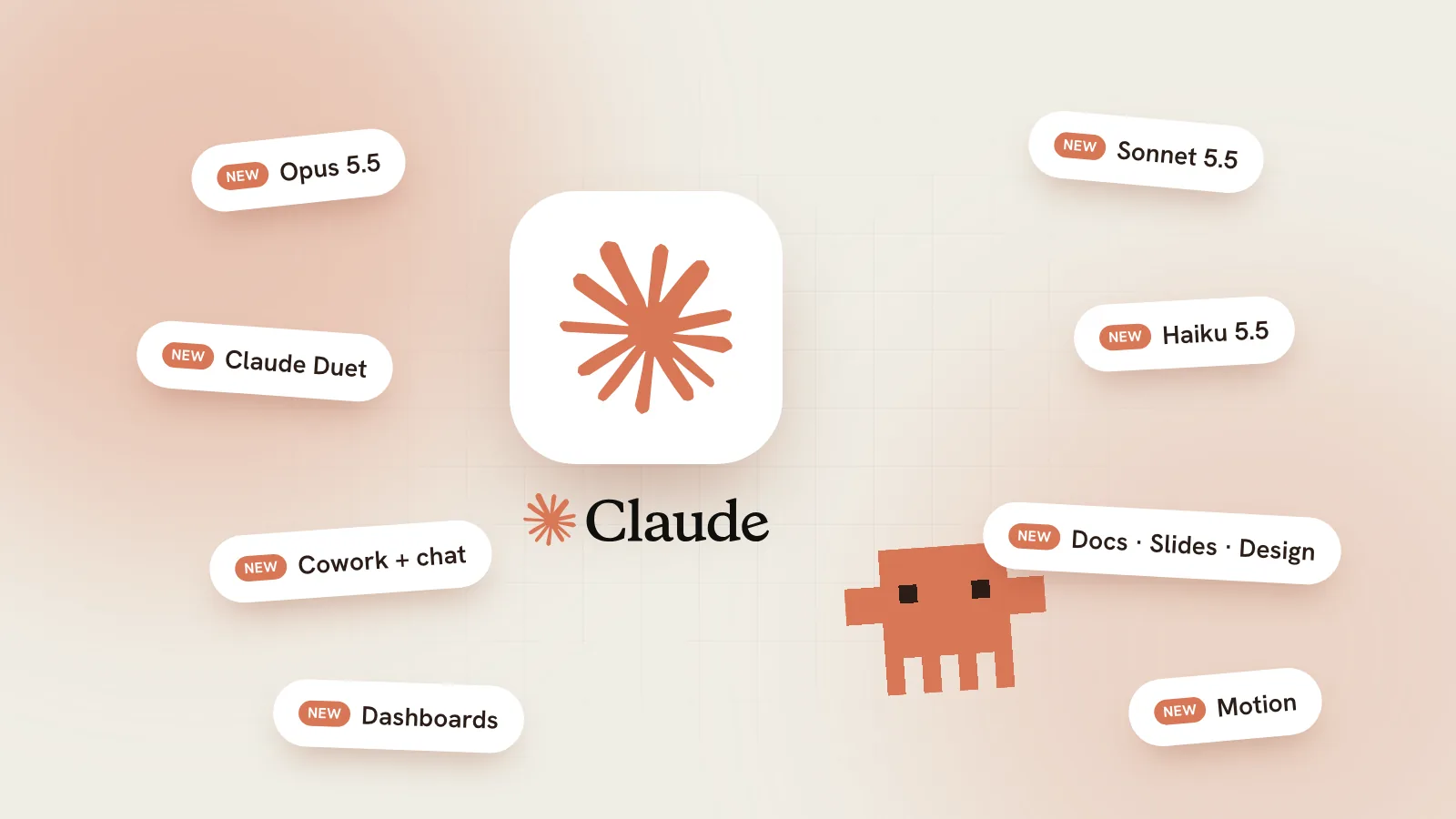
If you blinked in September or October, you missed a lot of Claude news. Anthropic shipped three new models, merged its chat and Cowork apps into one, moved its document and design tools out of beta, and announced an agent that works in the background for you. This guide pulls it all into one place: what each release is, who it’s for, what it costs, and what it actually changes if you run a small business or create content for a living.
What’s new in Claude in 2026? The short version
| Date | Release | What it is |
|---|---|---|
| September | Claude Fable 5.1 and Mythos 5.1 | Anthropic’s most advanced models for coding and knowledge work. Fable 5.1 is generally available; Mythos is limited to vetted organisations. |
| 22 Sept | Claude Opus 5.5 | The flagship of the 5.5 family, close to Fable 5.1 on most work at around 40% lower running cost than Opus 5. |
| 28 Sept | Claude Sonnet 5.5 | The everyday workhorse: over 30% faster than Sonnet 5 and up to 30% cheaper per task. |
| Sept–Oct | One Claude for chat and Cowork | Chat and Cowork merged for Pro and Max in September, then for Enterprise on 23 October. |
| 6 Oct | Claude for Google Workspace (beta) | A sidebar in Google Docs, Sheets and Slides, plus connectors that can edit your Google files. |
| 7 Oct | Claude Haiku 5.5 | Anthropic’s fastest, cheapest small model, at about 75% lower average cost than Haiku 4.5. |
| 8 Oct | Docs, Slides and Design out of beta | Available on every plan, including Free. Dashboards and Motion (animated explainers) arrived in beta. |
| 21 Oct | Claude Duet (research preview) | A proactive agent for Pro and Max users in the US, by waitlist. |
| 26–27 Oct | Claude for Nonprofits and Financial Advisors | Plugins with ready-made skills and connectors for those sectors. |
Sources: Anthropic’s newsroom and release notes. Dates are US time.
Claude Opus 5.5 vs Sonnet 5.5 vs Haiku 5.5: which should you use?
The three Claude 5.5 models are built for different jobs. A simple way to think about them: Opus for hard, long work where judgement matters; Sonnet for most everyday work; Haiku for quick, high-volume tasks.
| Opus 5.5 | Sonnet 5.5 | Haiku 5.5 | |
|---|---|---|---|
| Released | 22 September 2026 | 28 September 2026 | 7 October 2026 |
| Best for | Complex projects, long research, big coding jobs | Everyday writing, documents, slides and spreadsheets | Quick summaries, sorting, customer support, high volume |
| Speed | Over 30% faster output than Opus 5 | Over 30% faster than Sonnet 5 | The fastest Claude model |
| API price (per million tokens, input / output) | $4 / $20 | $2 / $10 | $0.10 / $0.50 (prompts up to 100k tokens) |
| Compared with the last version | About 40% cheaper to run than Opus 5 | Up to 30% cheaper per task than Sonnet 5 | About 75% cheaper on average than Haiku 4.5 |
API prices only matter if you or a developer build on Claude directly. If you use Claude in the app on a Pro, Max or Team plan, the practical change is that answers come back faster and Anthropic raised the five-hour usage limits on paid plans when Opus 5.5 launched. Pricing is from Anthropic’s announcements for Opus 5.5, Sonnet 5.5 and Haiku 5.5.
What’s actually better in Claude 5.5?
- Writing that gets to the point. Anthropic says Opus 5.5 puts key information first, and Sonnet 5.5 is a better writing collaborator than Sonnet 5.
- Documents, slides and spreadsheets. Sonnet 5.5 is pitched at polished everyday files, and scored close to Opus 5.5 on Anthropic’s knowledge-work benchmark.
- Using a computer and reading charts. Sonnet 5.5 jumped on computer-use and chart-reading tests, which matters for agents that click around websites for you.
- Cost and speed. All three are faster and cheaper to run than the models they replace, which tends to show up as higher usage limits and quicker replies.
- Safety. Anthropic says Opus 5.5 is less likely to take hard-to-reverse actions and resists prompt injection better.
What is Claude Duet?
Claude Duet is Anthropic’s proactive agent, announced on 21 October as a research preview. Instead of waiting for you to ask, it watches the apps you connect, such as email and calendar, sends you a morning briefing, and handles tasks like scheduling and drafting replies. It runs on Opus 5.5 and is on iOS, Android and claude.ai.
- Who can use it: Pro and Max subscribers in the US, through a waitlist. Team and Enterprise plans aren’t included yet.
- What it won’t do alone: according to coverage of the launch, Duet asks for approval before sending messages, spending money, signing documents or deleting anything.
- What it costs: there’s no separate price, but background activity counts towards your plan’s usage limits.
For a café owner or a coach, the appeal is obvious: a morning summary of bookings, enquiries and supplier emails, with replies drafted for you to approve. It’s a preview, so expect rough edges. The approval step is the right design. It’s the same principle Kebo follows in its Inbox: drafts in your voice, and you press Send.
Claude Cowork vs chat: what changed?
Until this autumn, Claude had a chat app and a separate Cowork mode for longer tasks that run code or work with files. They’re now one Claude on web, desktop and mobile. A conversation starts as an ordinary chat; when a task needs files or code, Claude carries on in the cloud and comes back with the finished document, analysis or deck. Your existing chats, projects, connectors, skills and plugins carry over. It reached Pro and Max in September and became generally available on Enterprise on 23 October, according to Anthropic’s announcement.
In practice: ask “turn last month’s sales export into a one-page summary with a chart” and you get a file back, not a block of text to copy into a spreadsheet yourself.
Claude Docs, Slides, Design, Dashboards and Motion
On 8 October Anthropic moved Docs, Slides and Design out of beta and onto every plan, including Free. Anthropic says people have already made more than 45 million docs, decks and designs in Claude. Two newer tools arrived in beta at the same time:
- Dashboards connect Claude to a data warehouse (BigQuery, Snowflake, Databricks and others) and to tools like Salesforce, and build live dashboards. Beta, paid plans.
- Motion turns a prompt into a short animated explainer you can export as an MP4. Reports say it’s in beta on Team and Enterprise only.
A day earlier, Claude for Google Workspace entered public beta with a sidebar in Google Docs, Sheets and Slides. If your business runs on Google’s tools, that’s the most practical release of the month.
What else did Anthropic announce?
- Industry plugins. Claude for Nonprofits (26 October) and Claude for Financial Advisors (27 October) bundle skills and connectors for those sectors. Expect more of these ready-made packs.
- Developer platform 2.0. On 21 October the Claude SDKs and command-line tool moved to version 2.0 with a new API version. Max and Team plans now include monthly API credits for running apps and agents.
- Agent Skills as an open standard. Anthropic is donating Agent Skills to the Agentic AI Foundation; more than 70 agent platforms have adopted it.
- An IPO filing. Anthropic filed for a proposed initial public offering on 26 October. It doesn’t change the product, but it’s why Claude is in the news this week.
What does this change for small businesses and creators?
Less than the headlines suggest, and more than nothing. The models are faster and cheaper, the apps produce finished files, and agents are starting to work in the background. What hasn’t changed is what makes social media work for a small business: content that’s clearly yours, replies that sound like a person, and showing up consistently.
How to use Claude for social media marketing
Here’s where the new Claude is genuinely useful for a business posting on Instagram, TikTok, Facebook or Threads, with prompts you can adapt:
- Turn customer questions into a month of ideas. Paste the questions you got by DM and email this month and ask: “Group these into themes and give me 12 post ideas, each answering one question in a sentence a customer would actually say.”
- Write captions in your voice. Give Claude five captions you’re proud of and ask it to describe your tone in bullet points, then reuse that description every time. Our brand voice guide shows how.
- Script short videos. “Write a 20-second Reel script for a physio clinic about desk stretches: a hook in the first two seconds, three on-screen text beats, and a call to book.”
- Draft carousels as a document first. Ask for a 7-slide outline with one idea per slide, then design it in your brand. With Docs and Design now on every plan, you can do both in Claude.
- Make sense of your numbers. Export your Instagram insights and ask Cowork for a one-page summary: what got saved, what got shared, and what to do more of next month.
- Prepare replies, then send them yourself. Paste a tricky DM and ask for three replies of different lengths. Keep the one that sounds like you.
The pattern is the same each time: Claude does the thinking and drafting, and you add what only you have, such as your photos, your opinions and your customers. Our small business social media playbook puts it into a weekly routine.
Where Kebo fits
General AI assistants are blank pages: you bring the context every time. Kebo is built for one job, social media for creators and small businesses, so it starts from your Brand DNA: your offer, your audience and the way you sound. From there, the Content Studio suggests ideas backed by posts working in your niche and designs carousels in your brand kit, and the Inbox drafts every DM and comment reply for you to approve. If you run a café, salon or shop, see social media for local businesses.