
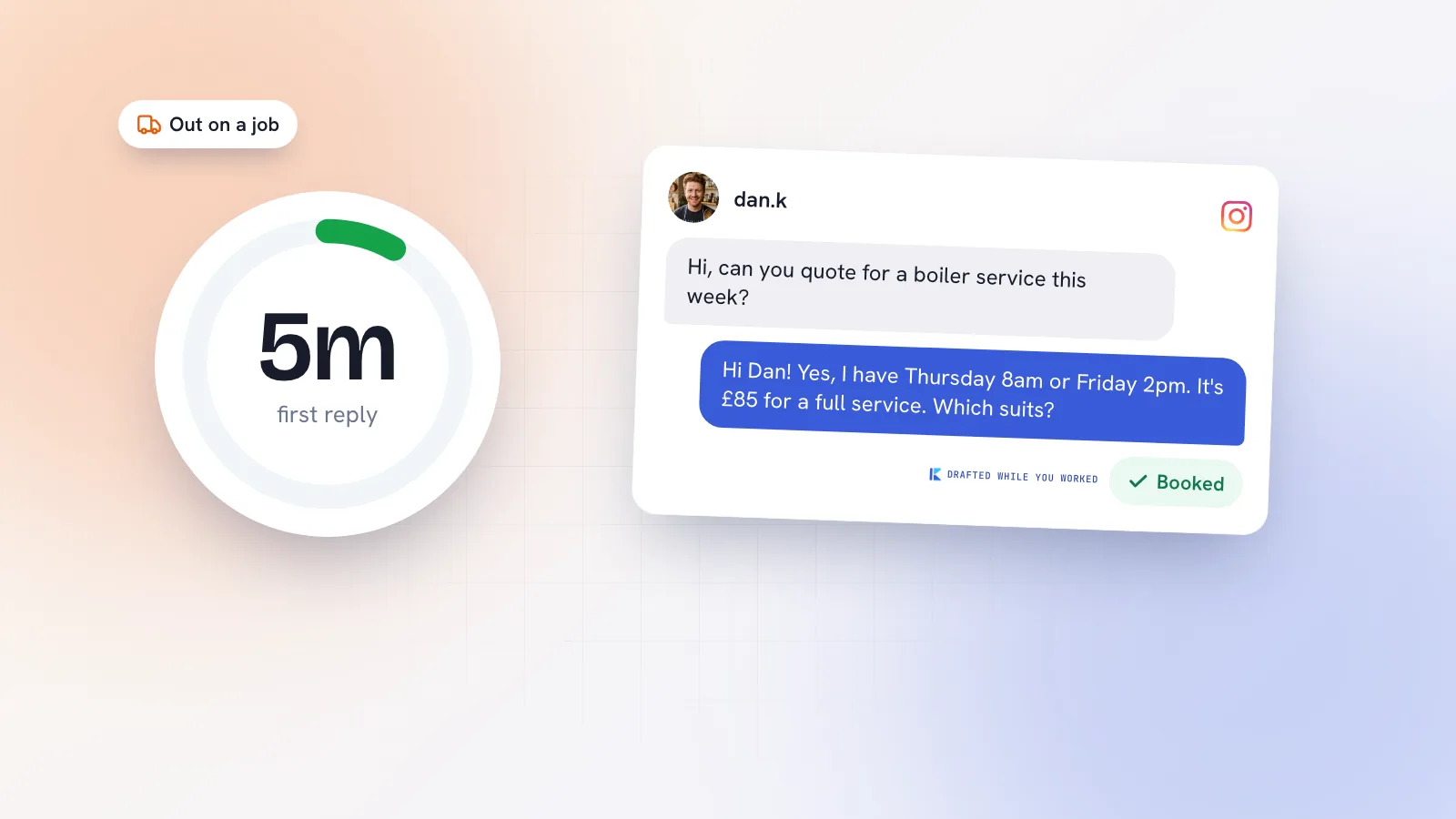
You're under a sink, halfway up a ladder or mid-colour with a client. Your phone buzzes: 'Hi, how much for a boiler service?' By the time you've washed your hands and looked, it's 5pm, and they've booked someone else. That gap between an enquiry arriving and you replying is what sales people call speed to lead. For cleaners, plumbers, electricians, landscapers, salons, clinics and photographers, it's often the difference between a full diary and a quiet week.
This guide does two things. First, it checks the statistics every speed-to-lead article quotes, because a lot of them don't hold up. Then it gives you a practical system for replying within the hour while you're on the tools, with 10 reply templates you can save today.
What is speed to lead?
Speed to lead is how long it takes you to give a real response to a new enquiry: a DM, a comment asking for a price, a WhatsApp, a voicemail, an email or a contact form. It's measured from the moment they get in touch to the moment they hear back from you, not from when you happened to see it.
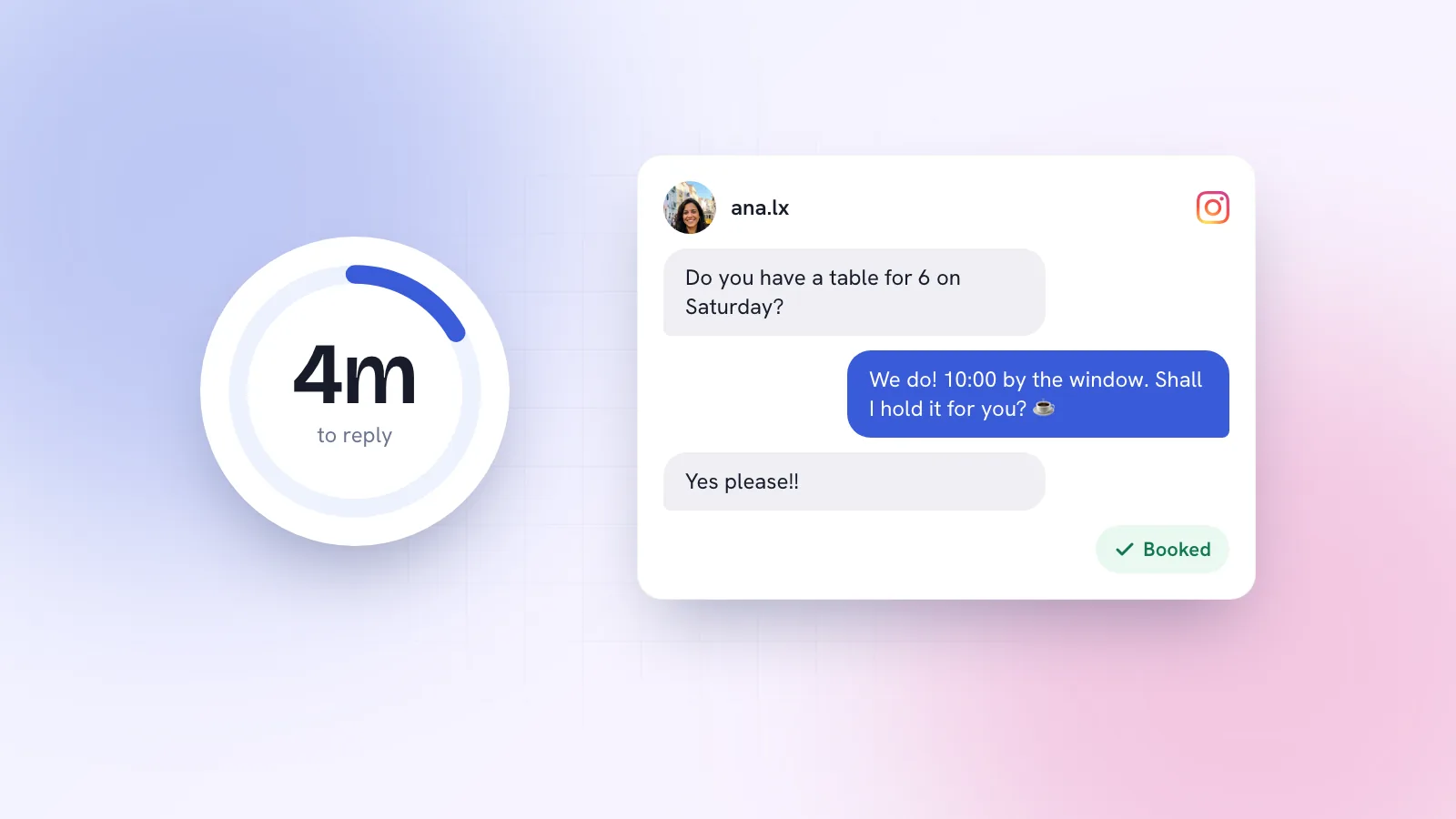
The idea is simple. When someone needs a gutter cleared or a wedding photographer, they usually ask two or three businesses at once. In our experience, the one who replies first with something useful, a price range, a date or a clear next step, tends to get the job. Everyone else is replying to someone who has already said yes.
Speed to lead statistics: which ones are real?
Search 'speed to lead statistics' and you'll see the same handful of numbers on hundreds of software sites. We traced each one back as far as we could. Here's what we found, as of November 2026.
| Claim you'll see | Where it really comes from | Our verdict |
|---|---|---|
| Calling within 5 minutes instead of 30 makes you 100x more likely to reach the lead and 21x more likely to qualify them | InsideSales.com and Dr James Oldroyd (then at MIT), presented in October 2007: 3 years of data from six companies, about 15,000 web leads and 100,000 call attempts | Verified in the original summary. Phone call-backs to web forms, vendor data, nearly 20 years old |
| Firms that respond within an hour are nearly 7x more likely to qualify a lead (and 60x more than those waiting 24 hours or more) | Oldroyd, McElheran and Elkington, 'The Short Life of Online Sales Leads', Harvard Business Review, March 2011: 1.25 million leads at 42 US companies | Verified via the article and press coverage at the time. 15 years old, US sales teams |
| Average business takes 42 hours to reply; 23% never reply | Same HBR article: test enquiries sent to 2,241 US companies | Verified. Same caveats on age |
| Only 7% of companies reply within 5 minutes | Drift's 2017 test of 433 business software companies | Secondary. Widely reported from Drift's own write-up; B2B software, not local services |
| 78% of customers buy from the first business to respond | Usually credited to 'Lead Connect' or Vendasta. No study has been found. The oldest similar line traced is a 2008 lead-software white paper saying 'in some industries', with no data behind it | Untraceable. Don't quote it |
| 35–50% of sales go to the vendor that responds first | Usually credited to InsideSales.com, but no report containing it has been found | Untraceable. Don't quote it |
The MIT / InsideSales study (2007)
This is the source of the '5 minutes vs 30 minutes' line. The original study summary says the odds of contacting a lead called within 5 minutes rather than 30 'drop 100 times', and the odds of qualifying drop 21 times. It also found the odds fall sharply within the first hour. Worth knowing: it was run on InsideSales.com's own call data (a company selling lead response software), presented at a marketing conference rather than published in a journal, and it says plainly it 'did not address close ratios'. So it's about reaching people, not about who wins the sale.
The Harvard Business Review study (2011)
This is the one people mean by 'the Harvard study'. In The Short Life of Online Sales Leads, the researchers sent web enquiries to 2,241 US companies: 37% replied within an hour, 16% within one to 24 hours, 24% took longer, and 23% never replied. Among those who replied within 30 days, the average wait was 42 hours. A separate analysis of 1.25 million leads at 42 US firms found that companies trying to contact a lead within an hour were nearly seven times as likely to qualify it as those that waited longer, and more than 60 times as likely as those that waited a day or more.
The article is paywalled; the figures above match the article's summary and press coverage at the time. Note that 'qualifying' a lead is a step in a sales team's process, not a sale.
What the evidence actually tells a plumber or a salon
Both real studies point the same way: interest fades fast, and most businesses are slow. But they measured sales teams phoning back web forms more than 15 years ago, before most enquiries arrived by DM. We haven't found a large, published study of response time for local service businesses on social media. So treat the numbers as direction, not law. You don't need the 78% to believe that the customer with a leaking pipe will book the first plumber who answers.
Where do service business enquiries come in?
Part of the problem is that enquiries arrive in six or seven places, and you only see some of them on the job. List yours honestly:
| Channel | Typical enquiry | Time limit to know about |
|---|---|---|
| Instagram DMs | 'How much for a deep clean of a 3-bed?' | Reply within 24 hours of their last message |
| Facebook Messenger | 'Do you cover Bromley?' | Reply within 24 hours of their last message |
| Comments on your posts | 'Price?' under a before-and-after | One private DM reply per comment, within 7 days |
| Photos of a damp patch | A 24-hour customer service window applies on the WhatsApp Business Platform | |
| Phone and voicemail | Emergency call-outs | None, but missed calls rarely leave a message |
| Email and website forms | Larger quotes, commercial work | None, but they're often sent to several firms |
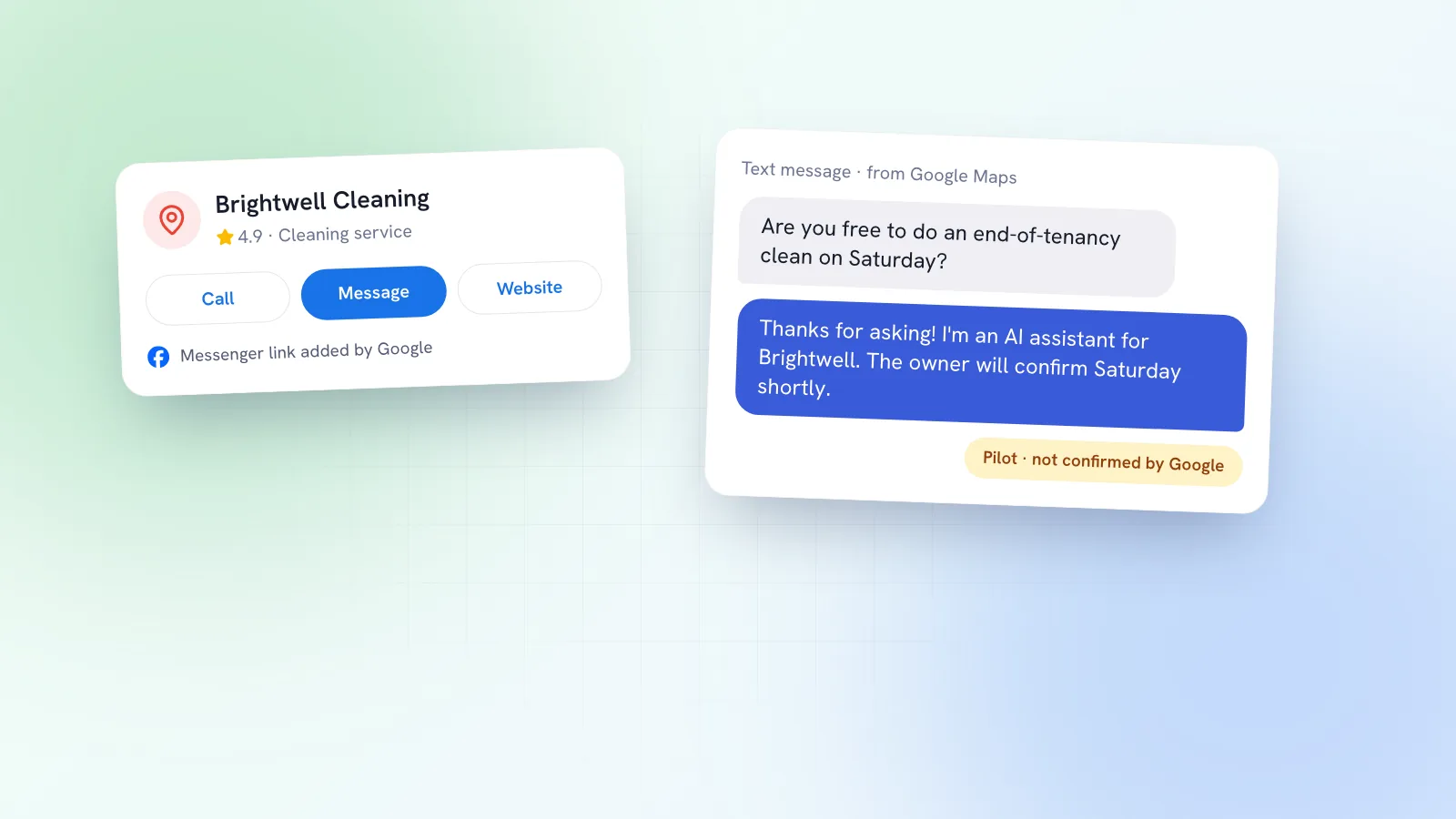
| Google Search and Maps | Calls and website clicks from your Business Profile | Google switched off Business Profile chat in July 2024 |
If you still think of Google as a messaging channel: Google ended chat on Business Profiles on 31 July 2024, so enquiries from Google now come through your phone number, website and booking links. Make sure those are right on your profile.
The 24-hour window on Instagram and Messenger
This is the one rule that turns a slow reply into a lost one. Meta lets businesses reply to Instagram DMs and Messenger messages within 24 hours of the customer's last message (Meta's Messaging API docs). Each time they write again, the clock restarts. Once it closes, you can't send a normal reply until they message you again.
For a trade that's out on jobs all week, the risk is the Friday-evening enquiry left until Monday. It's past the window, and the customer has probably booked someone else anyway. We go deeper on this in why replying to DMs within the hour wins sales.
How to respond to enquiries faster while you're on the tools
Nobody can reply in five minutes from a loft. The realistic aim for a small service business is a useful first reply within the hour during working hours, and the next morning for anything that came in overnight. Here's a system that gets you there.
- Put every channel in one place you check. Turn on notifications for DMs, Messenger, WhatsApp and missed calls only. Mute likes and follows, so a buzz usually means a possible job.
- Set fixed check-ins around your day. For example, before the first job, at lunch, between jobs and at 5pm. Five minutes each, phone out of the van, nothing else.
- Send an honest holding reply when you can't answer properly. 'Thanks! I'm on a job until 3. I'll send you a price this afternoon. Could you send a photo in the meantime?' It takes 20 seconds and keeps them with you.
- Save your answers. Prices from, areas covered, how quotes work, your booking link. Instagram, Messenger and WhatsApp Business all have saved or quick replies.
- Set expectations in your auto-replies and bio. An away message that says when you'll reply, and a link to your prices or booking page, answers half the questions while you work.
- Decide who covers. If a partner, office manager or apprentice can reply, give them the same saved replies, price list and diary access. If no one can, block 10 minutes at lunch.
- Batch the follow-ups. Once a day, go through anyone who went quiet and send one friendly nudge, while you're still inside the window.
10 reply templates for service businesses
Save these as quick replies and change the details in brackets. Each one answers what they asked and offers one next step.
| Situation | Reply |
|---|---|
| Quote request | Thanks for getting in touch! For a [job] like that we usually charge [£X–£Y], depending on [size/access]. If you send a couple of photos and your postcode, I'll give you a firm price today. |
| Availability | We've got [Thursday morning] or [Monday afternoon] free next week. Would either work? I can pencil you in now. |
| Price question ('how much?') | Good question! It depends on [size, materials, access], but most [jobs] like this come in between [£X and £Y]. Want me to send a proper quote? |
| After hours | Thanks for your message! I'm off the tools for today and reply from 8am. If it's urgent, call [number]. |
| Emergency | Sorry to hear that. If water's coming through, turn off the stopcock (usually under the kitchen sink). I can be with you by [time]. Can you send your address? |
| Photo needed | Could you send a photo or two of [the area / the fault]? It helps me give you an accurate price without a visit. |
| Booking confirmation | Lovely, you're booked in for [day, date] at [time]. I'll message the day before. Anything we should know about parking or access? |
| Follow-up after no reply | Hi [name], just checking you got the quote for [job]. Happy to answer any questions, and I've still got [day] free if that helps. |
| Review request | Thanks again for having us! If you were happy with the [job], a quick Google review would really help a small business like ours: [link]. |
| Out of area | Thanks for asking! We don't cover [area], sorry. [Business name] are good and closer to you. If you're ever nearer [your area], we'd love to help. |
Adjust the emergency one for your trade, and never give safety advice you wouldn't stand behind. For longer conversations about price objections and closing the booking, our Instagram DM sales scripts have 20 more. If people ask for prices in your comments, comment-to-DM moves them into a private chat without spamming.
How to measure your own response time
You can't fix what you can't see, and most owners guess their response time is faster than it is. Try this for one normal week.
- Log every new enquiry. A note on your phone is fine: channel, time it arrived, time you sent a real reply (not an auto-reply), and what happened: booked, quoted, went quiet or lost.
- Work out your typical time per channel. Look at the middle value, not the average, so one weekend enquiry doesn't skew it.
- Spot the gaps. Usually it's one time of day (mid-afternoon on jobs) or one channel (Messenger nobody checks).
- Compare outcomes. Were the jobs you lost mostly the ones you answered late? That's your own speed-to-lead evidence, and it's worth more than any statistic above.
- Add one check-in where the gap is, then repeat the week a month later.
Don't forget missed calls. Count them too, and call or text back every one within the hour, even with a 'Sorry I missed you, I'm on a job, can I call you at 4?'
How Kebo helps you reply first
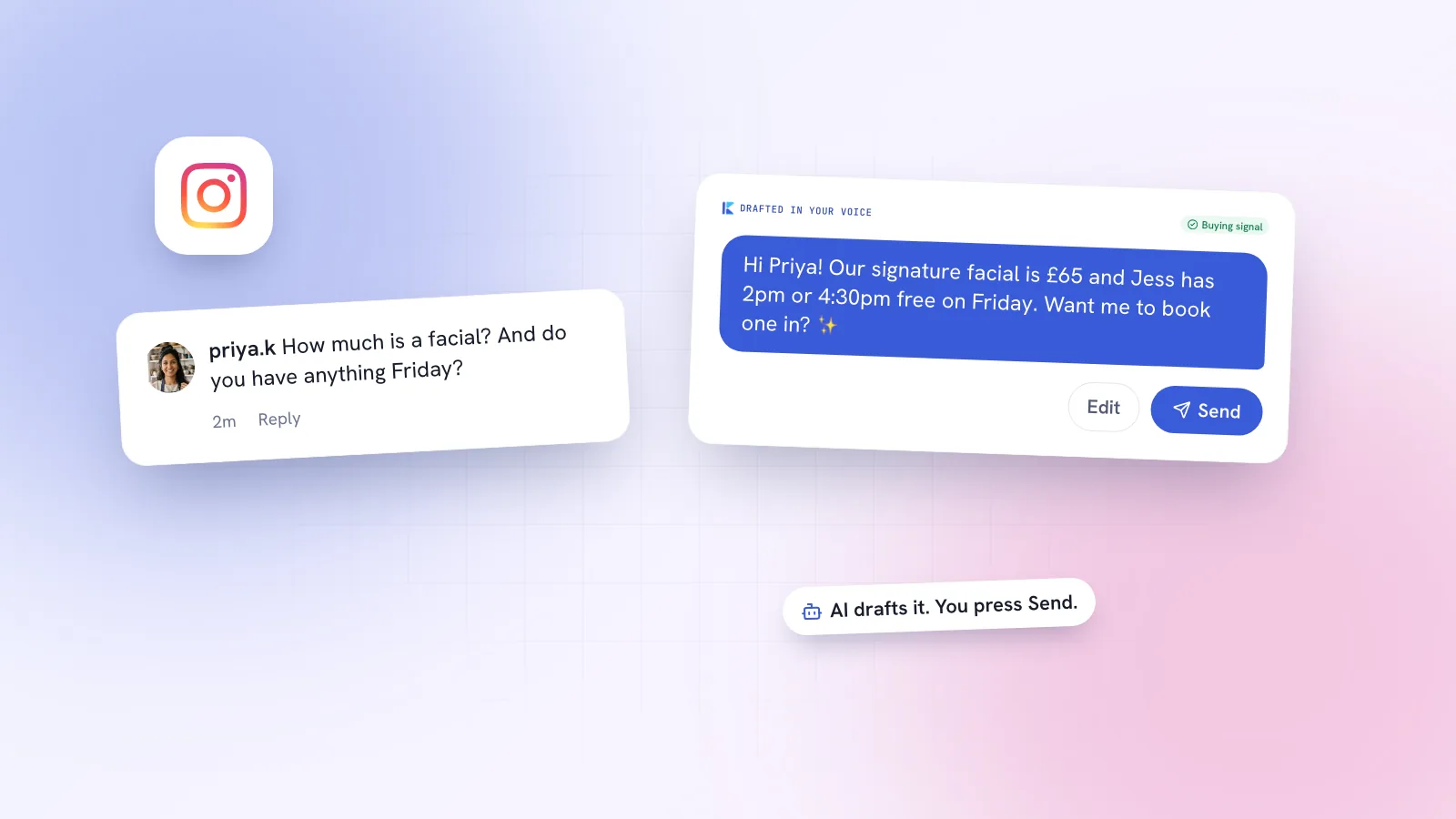
Kebo's Inbox brings your Instagram DMs and comments, and Facebook Messenger on the Growth plan, into one list. It drafts every reply in your voice, using a persona you've approved and your prices and services, and steers towards a booking. You read it and press Send, so a five-minute check between jobs clears a whole morning's enquiries. Each conversation shows how much of the 24-hour window is left, and comment-to-DM sends your own message when someone comments a keyword like PRICE.
To be clear about the limits: Kebo never messages anyone first, and it doesn't read WhatsApp, email or your phone. TikTok and Threads don't let third-party apps read DMs. Fully automatic replies, where Kebo answers on its own, are coming soon on the Pro plan. If you're wondering whether that's a good idea at all, we cover what AI replies can and can't do. For a week-by-week picture of how this fits a trade or local service, see Kebo for service businesses.